Online stores

Effective e-commerce means convenient shopping for your customers and efficient sales management for you.

For customers, what matters is a simple path from finding a product to buying it: intuitive use on mobile and desktop, easy product search, clear filters and up-to-date availability. Guest checkout, fast payments, convenient delivery options and easy returns complete an experience that encourages repeat orders.

For the seller, the store should make everyday work and business growth easier. Omnichannel sales and marketplace integrations let you handle orders from many channels in one place. Connections with CRM, ERP, warehouse and accounting systems keep stock levels in sync and enable automated logistics, invoicing and settlements. Multiple languages and currencies support international expansion, e-marketing helps you win customers and bring them back, and analytics and reporting let you evaluate results and plan further sales growth.

  • mv-logo
  • logo-nextbike
  • muve-logo
  • tezeusz-logo
  • czytelnia-logo

E-commerce implementation step by step

From idea to a store ready to grow

We run the whole implementation process: from understanding your sales model, through design and technology, to a safe launch and further development. At every stage you know what decisions we are making and what your business gains from them.

  1. The first step: let's talk

    Choose a convenient time for a short call. Tell us what you sell, what stage your e-commerce is at and what goal you want to achieve. We will suggest where to start and what information we need to prepare an accurate proposal for the next steps.

  2. We get to know your company and growth plan

    We look at your sales model, offer, customers and day-to-day order handling. We also talk about where you want to grow: new markets, B2B sales, a larger product range or additional channels. This way the store is built not only for launch, but also for the scale you are aiming for.

    Zespół podczas rozmowy o wynikach i rozwoju sprzedaży
  3. We analyse your needs and choose the technology

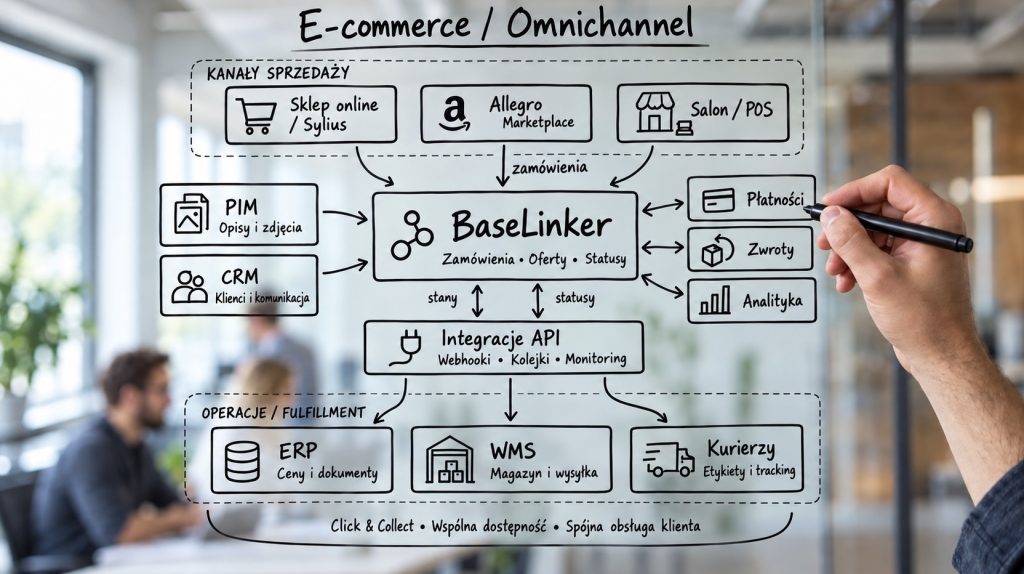
    We organise requirements, integrations and priorities. Among other things, we check the data flow between the store, the warehouse, payments, couriers and the systems your company uses. On this basis we choose the platform and the scope of work, so that your budget goes into features that really matter for sales and customer service.

    Schemat kanałów sprzedaży i integracji systemów e-commerce
  4. We design an experience that leads to a purchase

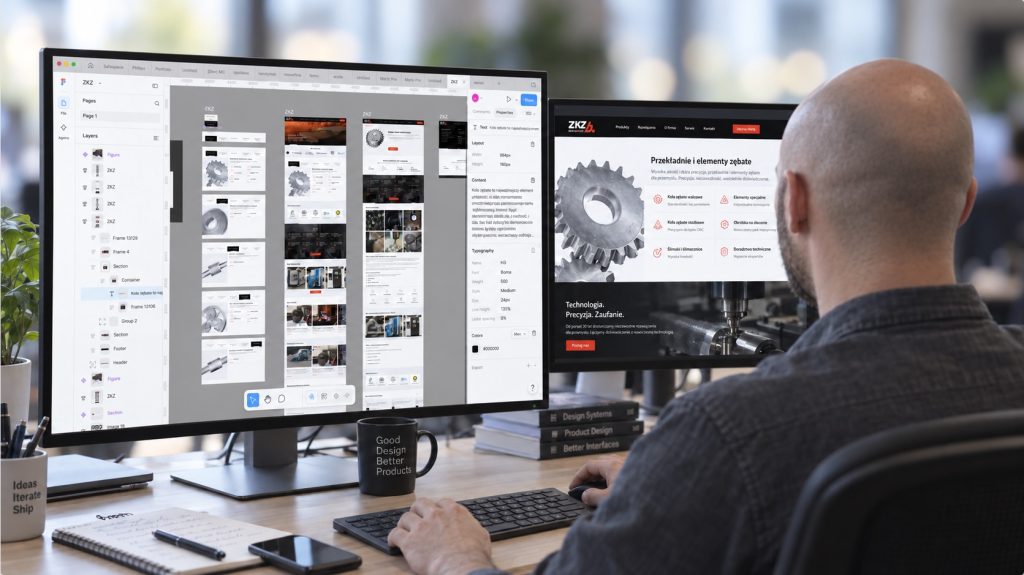
    We turn your sales strategy into a clear store architecture and a consistent visual design. We design the key journeys, from finding a product to completing an order, with mobile devices, your brand voice and your customers' needs in mind. You receive a design you can evaluate before development starts.

    Projektant tworzący interfejs sklepu internetowego
  5. We build the store and connect it to your systems

    We develop the approved views, configure the admin panel and set up the agreed integrations. We connect the parts responsible for products, orders, payments, deliveries and customer communication. We work in stages and test the key scenarios to confirm that the whole purchase process works before launch.

    Programista wdrażający sklep internetowy
  6. We set up hosting built for e-commerce

    We configure the technical infrastructure to match the expected traffic, catalogue size and number of integrations. We prepare the production environment, backups, an SSL certificate and monitoring of key services. Your store gets a stable foundation that can grow along with your sales.

    Administrator konfigurujący infrastrukturę i hosting sklepu
  7. We develop the store after launch

    After launch we support day-to-day maintenance and plan further improvements based on your business goals and sales data. We can optimise the purchase path, automate customer service and add new features in stages. Instead of a one-off project, you get a solution ready to respond to your company's growth and market changes.

    Specjalista rozwijający działający sklep internetowy

E-commerce delivery models

Direct delivery

End-to-end delivery

Want one partner to build your store? We agree on goals and scope with you, then run the project from analysis and UX, through development and integrations, to testing and launch. You make the business decisions, we coordinate the agreed implementation work.

Partner for software houses

Subcontracting / white-label

Running a project for your client and need e-commerce support? We can take over an agreed scope: the store, integrations or selected features. You keep the client relationship, and we work to shared standards. We can also work under your brand.

Support for your team

Staff augmentation / team extension

Have your own team but lack specific skills or time? Our specialists can join your process for an agreed period and level of commitment, including part of the week. You manage tasks and priorities, we support delivery within the agreed scope.

Technology that fits your sales model

WooCommerce or Sylius?

Both platforms can be a solid foundation for a store, but they meet different needs.

A platform built on WordPress

Works well where the purchase process is fairly standard, a fast time to market matters and content is an important part of sales.

Let's talk about WooCommerce
An e-commerce framework built on Symfony

Fits projects where custom sales rules, integrations or multiple channels are part of the competitive advantage and require full control over the code.

Let's talk about Sylius
The decision starts with the process

You don't have to choose the platform on your own

Tell us about your catalogue, orders and the systems your company uses. We will compare both options in terms of scope, maintenance and future development.

Let's talk about your store

Send us a brief for your online store

    E-COMMERCE

    Core e-commerce modules

    Standard modules create an online sales environment that can be developed and tailored to your needs.

    Product catalogue

    Organise your offer and show customers every product variant.

    • Products and variants
    • Categories and subcategories
    • Product attributes and options
    • Images and descriptions
    • Prices per sales channel

    Cart and checkout

    Guide the customer from choosing a product to placing an order.

    • Cart and quantity changes
    • Guest checkout
    • Shipping and billing address
    • Choice of delivery and payment
    • Order summary

    Orders

    Handle sales in one panel and track every fulfilment stage.

    • Order list and details
    • Fulfilment statuses
    • Payment and shipping statuses
    • Taxes and totals
    • Email notifications

    Payments

    Match payment methods to your market and how your customers buy.

    • Payment method configuration
    • Methods assigned to channels
    • Payment state handling
    • Order payment history
    • Gateways via integrations

    Shipping and availability

    Set shipping rules and keep track of product availability.

    • Shipping methods and zones
    • Shipping cost calculation
    • Shipping categories
    • Stock level tracking
    • Shipment status handling

    Promotions and discounts

    Create special offers with rules tailored to your sales.

    • Cart promotions
    • Catalogue promotions
    • Discount codes and coupons
    • Discount conditions
    • Promotion dates and limits

    Customers and accounts

    Give customers access to shopping and your team access to their data.

    • Registration and login
    • Customer profile
    • Address book
    • Order history
    • Customer groups

    Sales channels and API

    Expand your store to new markets and connect it with other systems.

    • Multiple sales channels
    • Languages and translations
    • Currencies and tax settings
    • Offer configuration per channel
    • Store and admin API

    Online stores: available integrations

    An online store is only as effective as the ecosystem of services it works with. We integrate the stores we build with payment, logistics, marketing and multichannel sales systems. We automate processes, reduce manual work and speed up order handling. Below are some of the integrations we implement most often.

    InPost

    Integration with InPost parcel lockers (Paczkomaty) and InPost courier: a map of pickup points right in the cart, automatic label generation and shipment status tracking. Customers choose a convenient parcel locker while placing the order, and shipping takes minutes instead of hours.

    Base (BaseLinker)

    Connecting your store with BaseLinker lets you manage sales from many channels in one panel: stock and price synchronisation, automatic order import and integration with couriers and marketplaces.

    FreshMail

    Automatic sign-up of customers to mailing lists, audience segmentation and personalised newsletters. Abandoned cart recovery campaigns and email marketing automation that really increase sales.

    PayU

    Fast and secure online payments: BLIK, instant bank transfers, payment cards and instalments. Automatic payment confirmation and refunds handled directly from the store panel shorten order processing time.

    Przelewy24

    One of the most popular payment gateways in Poland: BLIK, cards and hundreds of payment methods out of the box. Automatic transaction verification means paid orders go straight to fulfilment.

    AI agent

    An intelligent AI agent that helps customers choose products, answers questions about the offer and order status, and takes the load off your store's customer service, 24 hours a day, 7 days a week, in natural language.

    PayPo

    Deferred "buy now, pay later" payments and instalments. PayPo increases conversion and average order value: the customer pays up to 30 days after the purchase, while the store receives the money straight away.

    ZEN.COM

    A new generation payment gateway: cards, BLIK, instant transfers, Apple Pay and Google Pay in a single integration. Fast settlement and multi-currency support for international sales.

    Allegro

    Sell in your store and on Allegro at the same time: offers, prices and stock levels stay in sync, and orders are imported automatically into one panel. Full control over multichannel sales without doing the work twice.

    Google Merchant Center

    An automatic product feed for Google: Shopping and Performance Max campaigns always with up-to-date prices, images and availability. The foundation of effective product advertising in search.

    Google Analytics 4

    Full e-commerce tracking: analysis of purchase paths, conversions and the effectiveness of ad campaigns. We implement GA4 together with Consent Mode so that your data is complete and compliant with regulations.

    Subiekt (InsERT)

    Store synchronisation with Subiekt GT/nexo: stock levels, prices and product records are always up to date, and store orders go automatically into the sales system.

    Comarch ERP

    Integration with Comarch ERP Optima/XL: two-way exchange of product, stock and order data. A single source of truth for e-commerce, sales and accounting.

    Fakturownia

    Automatic invoices and receipts for orders, sent to customers by email. The store's accounting happens in the background, with no manual copying of order data.

    Ceneo and customer reviews

    A product feed for Ceneo with the "Buy Now" programme and automatic collection of post-purchase reviews (Ceneo, Opineo, TrustMate). Visibility in a price comparison site and social proof that convinces undecided shoppers.

    FAQ - Online stores

    There is no single answer to this question. First, focus on the requirements you have for your store. As a future investor, ask yourself 3 key questions before launching an online store:

    1. Are your products standard, or do they require special procedures?

    2. What matters more: the cost of implementation, or quality and meeting all requirements?

    3. Do you already have knowledge of e-commerce and technology?

    Based on the answers, we can put together a set of tools that will help you build your online store.

    We do not believe in one platform that is good for everything. We choose the store engine to match the scale of the business, growth plans and budget, which is why we work with two proven technologies.

    WooCommerce is the best choice for small and medium-sized stores. It offers low implementation and maintenance costs, a very fast start of sales and the largest community and extension ecosystem of all e-commerce platforms. WooCommerce is built on WordPress, the most popular CMS in the world, so from day one the store supports content marketing and SEO, and the owner can manage content and design on their own.

    Sylius is a platform for stores that outgrow the standard. Built on the Symfony framework, it gives complete freedom to implement custom processes: individual price lists and B2B sales, multiple countries, languages and currencies in one installation, advanced promotions and integrations with ERP systems, BaseLinker and marketplaces. Sylius is open source software with no licence fees and no commission on sales, so costs do not grow with your store’s turnover.

    Not sure which platform suits your business? Let’s talk. We will give you honest advice, even when a cheaper solution turns out to be enough.


    Our clients very often ask us to build non-standard online stores. In fact, we specialise in stores that are 100% tailored to our clients’ needs. Such stores require a flexible choice of technology and a broad view of the problems that will come up during implementation and while the store is running. Keep in mind that today’s online stores are systems that constantly communicate with other systems, so integrations and data exchange with external providers are fundamental to how a store works. In such cases we want more control over how information flows, so we need full control over the store’s core functions. We use the Symfony PHP framework as our foundation for building online stores and e-commerce related products, meaning systems that sell products and services but also handle many other processes, for example a client’s internal procedures.

    The cost depends on the platform, the scope of features and the number of integrations. A simple store on an off-the-shelf platform is an investment in the range of PLN 10,000 to 20,000, while advanced projects with ERP and marketplace integrations and custom features are priced individually. After a short brief, we prepare a specific quote together with a project schedule.

    A typical project takes 6 to 12 weeks: from wireframes and visual design, through implementation and integrations, to testing and data migration. Stores with advanced integrations (ERP, marketplaces, fulfilment) may need more time. We agree on an exact schedule before work begins.

    Yes, we carry out migrations between platforms (for example from PrestaShop or Magento to WooCommerce or Sylius), including products, customers and order history. We take care of 301 redirects and preserving your visibility in Google, so that changing platforms does not mean losing traffic and sales.

    That is our speciality. We connect stores with, among others, Subiekt (InsERT), Comarch ERP and Fakturownia. Stock levels, prices and orders synchronise automatically, and sales documents are issued without manual work. You will find a list of the integrations we implement most often above on this page.

    Yes. We implement an intelligent AI agent (agent001.ai) that helps customers choose products, answers questions about the offer and order status, and takes the load off your customer service 24/7. Artificial intelligence also helps create product descriptions, recommendations and marketing automation.

    Our work does not end on launch day. We provide technical support, security updates, performance monitoring and further development of the store with new features and integrations. Most of our clients have been growing their stores with us for years.

    Let’s talk
    about your project

    +48 506 160 480
    biuro@okinet.pl

    or write to us